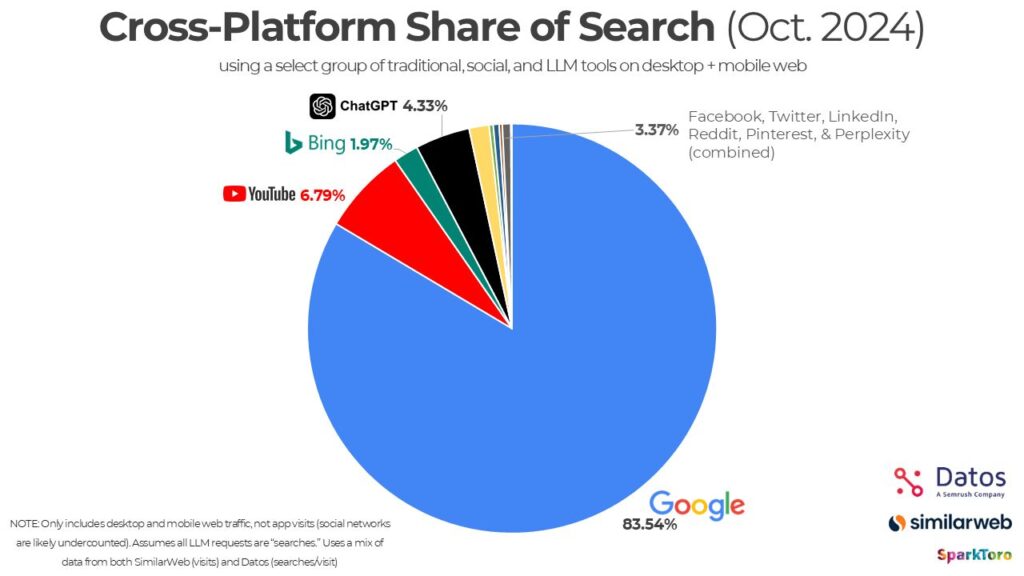
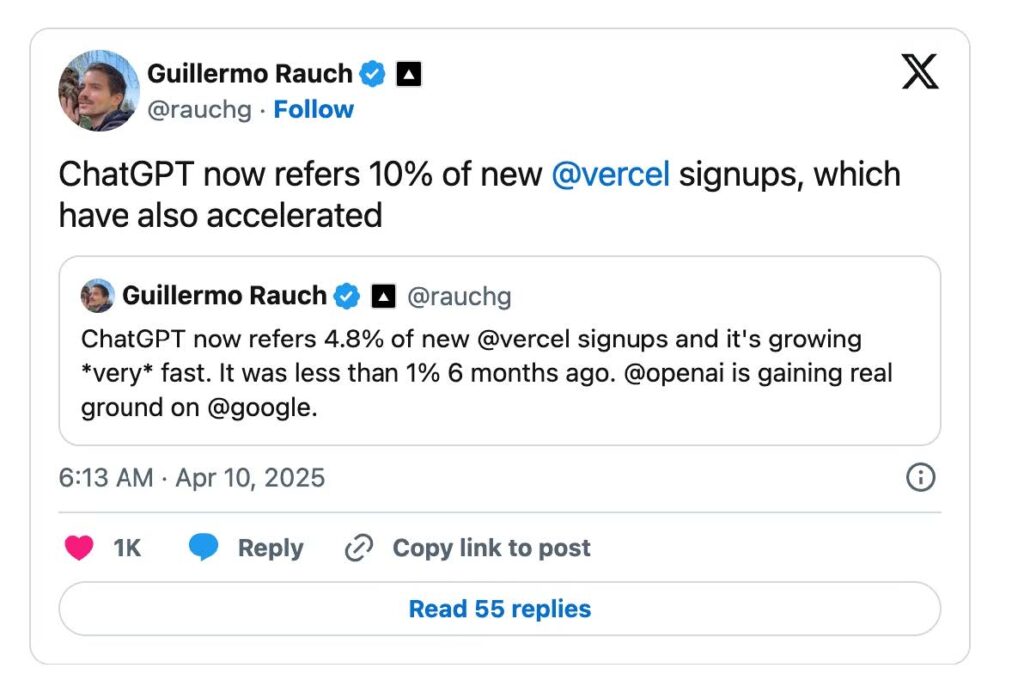
AI is increasingly influencing every part of marketing, including the starting point of how people look for information and how marketers conduct their day-to-day marketing activities. Last year, Rand Fishkin, co-founder and CEO of SparkToro, shared a chart on X that sparked wide discussion across the industry. While the data was, as he openly admitted, “messy”, it offered one of the clearest snapshots of where search traffic was heading — showing that ChatGPT had already taken 4.33% of search activity. The conversation gained further momentum this April when Vercel CEO Guillermo Rauch revealed that 10% of Vercel’s new signups now come from ChatGPT referrals.
ChatGPT may have the spotlight, but it reflects a broader behavioural shift across AI-powered search and discovery experiences.
Zero-Click Search Is the New Norm
With ChatGPT, Perplexity, Gemini and Google AI Overviews, the role of websites has shifted from first touchpoint to supporting references, a change most visible on Google. A 2024 study using data from Datos (owned by Semrush), found that 58.5% of Google searches in the US and 59.7% in Europe end with zero clicks. As snippets and AI Overviews delivered summarized answers, users often no longer required to visit a website. The rise of zero-click searches highlights how content consumption behaviour has fundamentally changed.
As a result, websites are no longer the primary entry point for discovery, but a source AI models draw on to generate answers. SEO therefore plays a different role, shifting from driving clicks to ensuring content is clearly written, well-structured and easily interpreted by AI models, so it can be accurately referenced within AI-powered search results. While AI is often discussed in the context of shifting user behaviour, its influence extends well beyond search and discovery, reshaping how marketing teams plan and execute their work.
How Marketers Are Adapting to AI
AI has quickly moved from an experimental tool to a core part of everyday marketing workflows. According to Synthesia, 55% of marketers now use AI for content creation, saving an average of 3 hours per piece of content — a clear signal of how embedded AI has become in marketing operations. Usage patterns show that 45% of marketers use AI for inspiration, 31% for outlining, 18% for drafting, and only 6% for full writing. This indicates that AI is primarily used as an assistant rather than a replacement, shifting the conversation from adoption to how it delivers the most value.
What AI Can and Still Can’t
To better understand where AI delivers the most value in marketing, it is useful to look into how it supports workflows and where human input still essential. In Averi’s study of 100 marketers, respondents widely agreed that AI excels at operational tasks, such as processing information quickly, improving structure, enhancing clarity and adapting tone. As a result, 84% said AI helps them deliver high-quality output more efficiently.
However, its limitations remain clear. 92% said AI cannot replace creative originality, which depends on generating new ideas rather than recombining existing ones. 83% noted that long-term strategic thinking still relies on human judgment, and 76% pointed to cultural understanding and nuance as ongoing challenges in AI usage. These gaps help explain why only 6% of marketers trust AI with full content creation. While AI can accelerate execution, human-led storytelling and strategy remain irreplaceable.
From Theory to Practice: How Brands Are Using AI
With clearer boundaries around where AI adds value, brands are increasingly applying it in practical ways. One of the most visible shifts is in creative production. With more than half of marketers using AI for image and video generation, ideas that once felt unrealistic — due to time and production constraints — are now much easier to bring to life. Here are a few examples:

How AI will reshape marketing is no longer a question of if, but how brands respond to its growing role in discovery and content consumption. As AI models and interfaces such as ChatGPT and Perplexity, alongside China’s DeepSeek and Doubao, become everyday entry points for discovery, early-moving brands have the opportunity to shape how they appear in AI-led search experiences and secure an advantage in this emerging landscape. If your team is considering how to build AI-ready content, get in touch with us to view reference demos of AI-generated video.
Sources: HubSpot, Semrush, HBR, Forbes, Salesmate, Workduo